Density, distribution function, quantile function, and random
generation for the sinh-arcsinh distribution with four parameters
mu, sigma, nu, and tau.
Usage
dsinharcsinh(x, mu = 0, sigma = 1, nu = 1, tau = 1, log = FALSE, cores = NULL)

psinharcsinh(
  q,
  mu = 0,
  sigma = 1,
  nu = 1,
  tau = 1,
  lower.tail = TRUE,
  log.p = FALSE,
  cores = NULL
)

qsinharcsinh(
  p,
  mu = 0,
  sigma = 1,
  nu = 1,
  tau = 1,
  lower.tail = TRUE,
  log.p = FALSE,
  cores = NULL
)

rsinharcsinh(n, mu = 0, sigma = 1, nu = 1, tau = 1, cores = NULL)
Arguments
- x
vector of (non-negative integer) quantiles.
- mu, sigma, nu, tau
vector of (non-negative) parameters.
- log, log.p
logical indicating whether probabilities p are given as log(p).
- cores
integer. Number of cores/threads to be used (requires OMP support).
- q
vector of quantiles.
- lower.tail
logical indicating whether probabilities are \(P[X \le x]\) (lower tail) or \(P[X > x]\) (upper tail).
- p
vector of probabilities.
- n
number of random values to return.
Details
The Sinh-Arcsinh generalizes the Normal distribution by separately
controlling location, scale, skewness, and tail-heaviness and can thus produce a
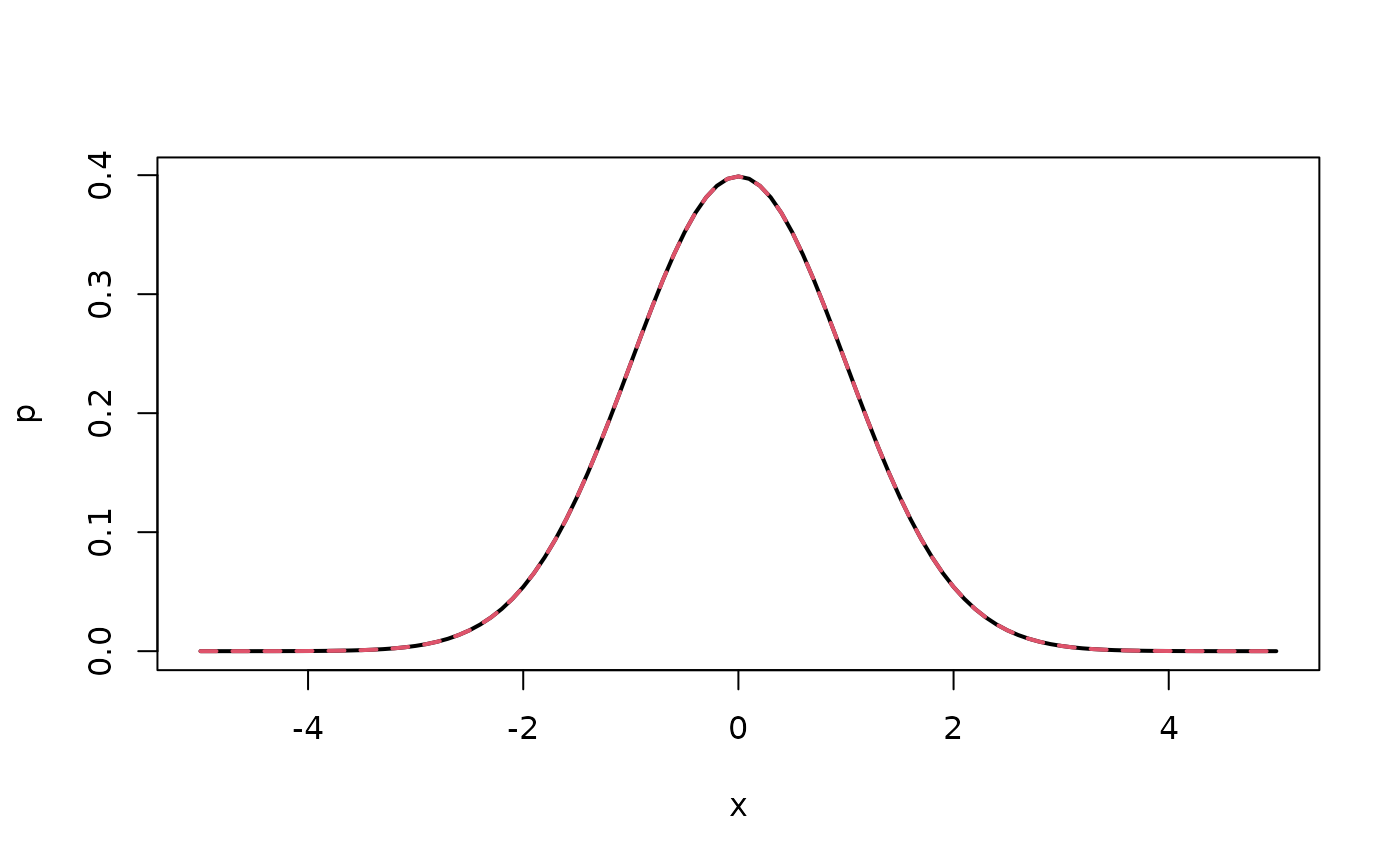
wide range of shapes. Using nu = 1 and tau = 1 results in a
normal distribution.
All functions follow the usual conventions of d/p/q/r functions in base R.
Examples
## theoretical probabilities for a Sinh-Arcsinh distribution
## with mu = 0, sigma = 1, nu = 1, tau = 1 (default) the Sinh-Arcsinh distribution
## corresponds to the standard normal distribution
x <- seq(-5, 5, by = 0.1)
p <- dsinharcsinh(x)
plot(x, p, type = "l", lwd = 2)
lines(x, dnorm(x), col = 2, lty = 2, lwd = 2)
 ## corresponding empirical frequencies from a simulated sample
## with mu = 5, sigma = 3, nu = 0.7, tau = 0.7
set.seed(0)
y <- rsinharcsinh(500, mu = 5, sigma = 3, nu = 1.1, tau = 0.7)
hist(y)
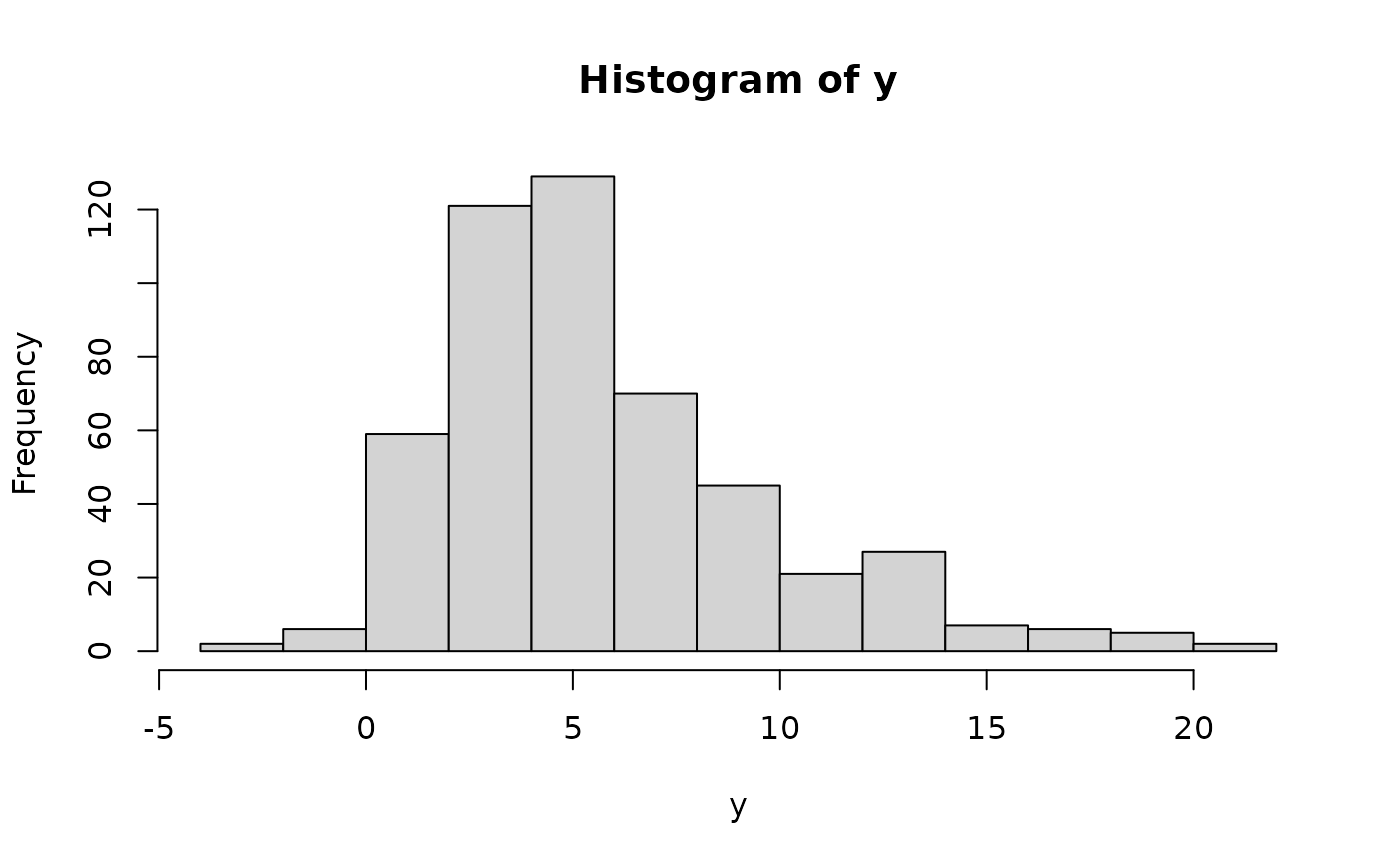
## corresponding empirical frequencies from a simulated sample
## with mu = 5, sigma = 3, nu = 0.7, tau = 0.7
set.seed(0)
y <- rsinharcsinh(500, mu = 5, sigma = 3, nu = 1.1, tau = 0.7)
hist(y)
 ## the quantile function is the inverse of the distribution function
psinharcsinh(qsinharcsinh(0.7))
#> [1] 0.7
qsinharcsinh(psinharcsinh(3))
#> [1] 3
## inversion using custom parameters mu = 5, sigma = 2, nu = 0.7, tau = 1.3
psinharcsinh(qsinharcsinh(0.7, 5, 2, 0.7, 1.3), 5, 2, 0.7, 1.3)
#> [1] 0.7000014
qsinharcsinh(psinharcsinh(3, 5, 2, 0.7, 1.3), 5, 2, 0.7, 1.3)
#> [1] 3
## the quantile function is the inverse of the distribution function
psinharcsinh(qsinharcsinh(0.7))
#> [1] 0.7
qsinharcsinh(psinharcsinh(3))
#> [1] 3
## inversion using custom parameters mu = 5, sigma = 2, nu = 0.7, tau = 1.3
psinharcsinh(qsinharcsinh(0.7, 5, 2, 0.7, 1.3), 5, 2, 0.7, 1.3)
#> [1] 0.7000014
qsinharcsinh(psinharcsinh(3, 5, 2, 0.7, 1.3), 5, 2, 0.7, 1.3)
#> [1] 3